The History of Data Communications
Click:
The history of data communications is closely linked to the developments in cabling and the connecting hardware. High-performance data networks and local area networks (LANs) cannot perform well without appropriate cables and connectors. When we take a look at high-speed data networks like Gigabit and 10 Gigabit Ethernet, it’s hard to imagine that these data networks descended from telephone networks. LAN Technologies have evolved greatly over the years and Ethernet has become the dominant technology for LANs.
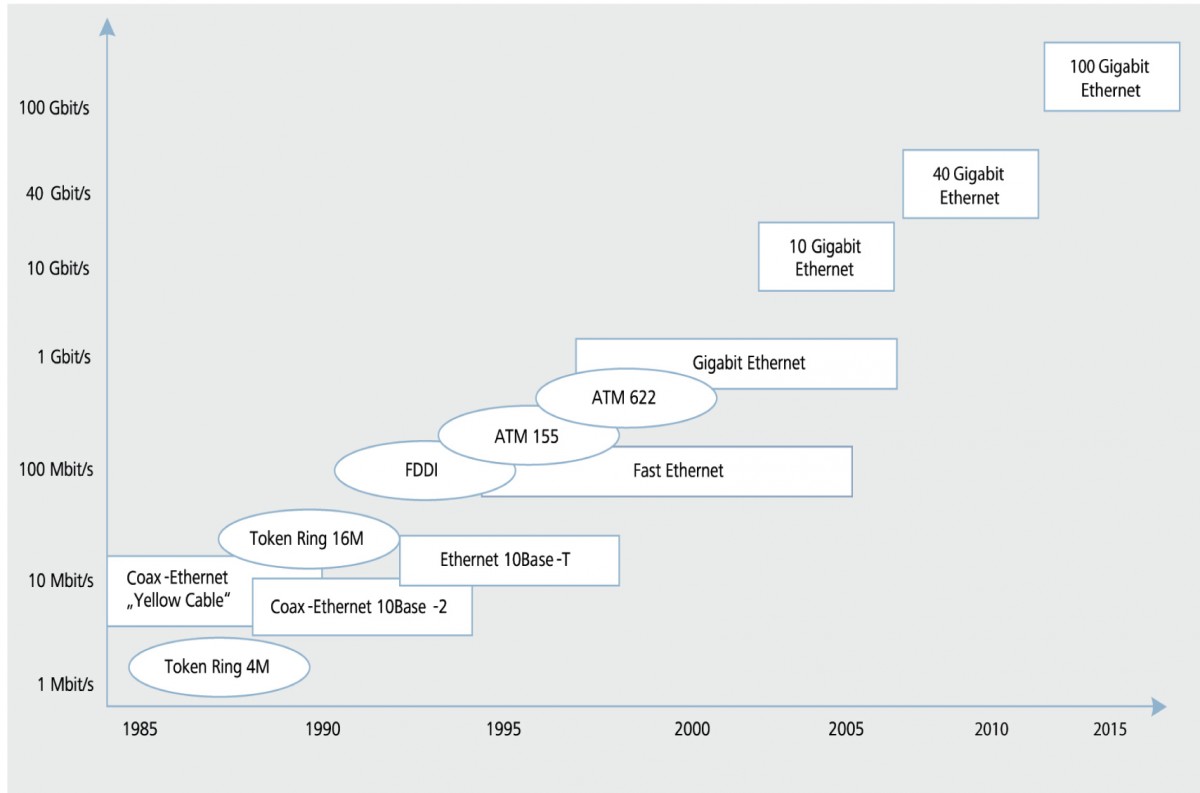
Due to the evolution of technology and the greater demand for higher networking speeds, cable and components have been developed that can transmit faster speeds over longer distances. Copper classes and categories were introduced in order that network parameters could be clearly defined and that the appropriate connecting hardware was installed. For example, Category 3 was introduced in the later part of the 1980s and could support voice services as well as 10BASE-T Ethernet. However, this would eventually become unsuitable by the mid 1990s as Category 5 had become widely available and was able to support faster network speeds up to 100Mbps. The next wave of cable and connector development came in the form of CAT5E, which could more effectively support Gigabit network applications. CAT5E is an enhanced version of Category 5, however, CAT5E standards had introduced new and more stringent crosstalk specifications, which allowed Gigabit network applications and high data transfer scenarios to function more reliably.
Over the last 5 to 8 years, Category 6 (CAT6) cable and connectors have become a basic requirement for new buildings in order to support Gigabit network applications and support bandwidths of up to 250MHz. CAT6 is also beginning to replace CAT5E in residential environments. Category 6A (CAT6A) which supports data rates of 10G up to 100 metres and a bandwidth of up to 500MHz has begun to grow in popularity. Many Data Centres, hospitals and universities have adopted CAT6A as a new minimum requirement. Other developments in CAT7, CAT7A and also CAT8 are continuing, which will support even higher data transfer rates and bandwidths.
Standard (Name) | Maximum Bandwith | Maximum Distance | Maximum Data Rate | Notes |
| Level 1 (CAT1) | 0.4MHz | 1Mbps | Unsuitable for modern systems | |
| Level 2 (CAT2) | 4MHz | 4Mbps | Unsuitable for modern systems | |
| Category 3 | 10MHz | 10Mbps | Basic voice, 10BASE-T Ethernet | |
| Category 4 | 20MHz | 16Mbps | Not commonly used | |
| Category 5 | 100MHz | 100 meters | 100Mbps | Not commonly used |
| Category 5e (Class D) | 100MHz | 100 meters | 1Gbps | Still commonly used for residential application and everyday use |
| Category 6 (Class E) | 250MHz | 100 meters (55 meters) | 10Gbps (limited distance) | Used in new buildings |
| Category 6A (Class Ea) | 500MHz | 100 meters | 10Gbps | Data centres and commerical |
| CAT 7 (Class F) | 600MHz | 10Gbps | Fully shielded components. Non-modular connectors | |
| CAT 7a | 1000MHz | 10Gbps | Fully shielded solutions | |
| CAT 8 | 1600-2000MHz | 40Gbps | In development |

点击右上角
分享给朋友吧







 Long by picture save/share
Related Articles
-

Network Cables
View Details -
Telecom & FTTP Networks
View Details -
The History of Data Communications
View Details -
Comparison of CAT6 vs CAT6A cabling ?
View Details -
Cat5e vs. Cat6: What's the Difference?
View Details -
Applications of Coaxial cable
Coaxial Cables : Features and Its Applications
View Details -
Security Camera Cable
View Details -
What is the real difference between CAT6 and CAT6A?
View Details -
Data Centre Cabling
Discover the basics of data centre cabling, including cable colour standards, types, and more from our guide for cable installation and management in a data centre.
View Details